Magnus Carlsen was winning so much, he was tired of it. He wasn’t even sure how he was winning anymore; he just played the move that felt right at the time, and had stopped calculating things out years ago.
He even tried to lose once, blundering a piece thinking that it didn’t matter anyway – that nothing really mattered in that moment, and it just felt like a stupid mistake he thought was worth making.
His opponent managed to snatch defeat from the jaws of victory, though, nonetheless, and he still won the game.
Maybe it was a curse, but if it was, then it was the kind of talent that others would kill for, and for which he never recalled having asked to be given.
Either way, there it was. He had it, and he couldn’t give it away, no matter how hard he tried.
He taught others, but none of his students ever even came close to his understanding of the game.
He wrote theory, and commented on games throughout history, adding his footnotes alongside the greats – from Philidor to Kasparaov (with whom he’d even had dinner in Oslo a few years back, and yet still felt something disparate and unspoken preventing their agreement over much of anything of great importance, although they did both agree the duck was lovely) – but he simply could never accurately communicate his perspective when it came to his “Philosophy of the Game.”
Here it was, in a nutshell: He couldn’t be allowed to know, because if he knew why he was so good at Chess, it would be the thing that ended his talent.
It sounded religious, and most people scoffed at that.
It sounded conceited, and more people scoffed at that.
Even very religious people refused to accept his position unless he agreed to share their god, none of which seemed particularly real or accurate to him in terms of what “The Almighty” might be, and even very conceited people refused to accept his position, simply because he wasn’t them.
The whole thing felt like a Faustian deal with The Devil to Magnus. Even his name meant “great,” after all, but he wasn’t given any choice over that, so the problem that he faced was to identify exactly when and how he had “earned” his talent… and if he didn’t earn it at all, then to what power or powers he owed his life.
Fortunately, he was very good at solving problems.
Chess is an incredibly complex game, and his five-year-old mind was adept at not only learning the rules, but studying the various algorithms of movement and interaction between the pieces that kept him occupied for hours on end, just playing and defeating various imaginary opponents, which made it that much easier to predict the best response to his real-life ones when he’d play other people.
In 1950, Claude Shannon calculated the total possible number of moves in the game to be about 10120, which means 1 followed by 120 zeroes. If you’d like to write that out and discover how long it takes to even numerically represent that amount, you are free to do so, but Magnus figured out pretty early that such an exercise would be a waste of time. It might not be to you, however; Magnus has no opinion to my knowledge on how you spend your time. If you want to be more sensible, the number can be revised to 1040, but that still seems like a lot to count.
Claude wanted to find out what it would take to program a computer to play Chess, and what kind of processing power is required, and moreover how to solve all the mysteries of game-tree complexity, which suggests that any mathematically representable game of computation could be won through brute force, provided that one had a sufficiently powerful calculator.
His theory that it was thoroughly improbable for any such computer to exist that could win the game through sheer calculation, and at the time he posited it, there was no one who could reasonably disagree. The United States Government, after all, which had at least as much (if not the most) access to technology compared to every other country on the planet, had just unveiled the UNIVAC 1101, which ran on vacuum tubes and punch-cards to mechanically process analog calculations through electricity. It looked like the cockpit of the Enterprise; warp-speed with dials.
But then came the microcomputer, whose name came from Asimov’s short story “The Dying Night,” and which didn’t become a reality until Japanese Sord Computer Corporation’s SMP80/08 hit in 1972, and the game theory of Game Theory started accelerating exponentially – not to the power of 120, or even 40, but certainly to some logarithmic degree. Even just doubling every other year was enough, as it turned out, to produce machines that could beat most human opponents while taking up little more space than an average board itself would by the mid-1970s – almost two decades before Magnus found himself being brought into the world.
The topic of conversation over that duck dinner was still haunting him, and it was Kasparov’s insistence – based on an impossible argument of faith – that computers “would never win in the end” which irked him so much that he had to devise a test to figure it out.
Kasparov literally beat the entire world in 1999 through an Internet demonstration wherein any humans who could communicate online were able to vote on the move played against him (to simplify the issue, he was allowed to make the first move). Computers were allowed to kibbitz, and grandmasters were readily available with recommendations for the public.
He wasn’t surprised to win, but he did realize why it was that he had lost to Deep Blue in 1997, and why he refused to play another demonstration against a computer. He had not lost his confidence, as some suggested, nor was it that he tried to play unlike himself (they had programmed Deep Blue specifically to include every game he had ever played, so it was sort of like a battle with his own ego) which had led to his loss. What he learned from that match, and confirmed through his experience playing the world after that, was that it was exactly the degree to which he was not a machine that ensured his losing against the machine.
Magnus thought this was a religious conjecture, some belief in humanity’s failure and inherent inferiority which corrupted the argument, but since he was also human, and had lost to computers before, he couldn’t establish the ethos to properly respond. Humans had deferred to computers in almost every other area in terms of mathematical calculation, and it seemed just like the natural order of things for this to result in computers telling humans what they could and couldn’t do, and if Kasparov couldn’t see that, then there was nothing he could do to communicate otherwise.
It infected him with self-doubt. His play became less stable, and yet it seemed like the more he tried to calculate like a computer, the less he was winning. He moved only when he saw the best one – but he also had to feel it, in some exquisitely inarticulate way that he couldn’t even describe to himself, much less another player, even if they were also a Grandmaster.
The fact that they didn’t even fundamentally disagree on the matter only made things worse.
Magnus also knew that computers “would never win in the end.“ And he had finally, he surmised, developed a way to test that theory.
The answer lay in its simplicity.
The D-Wave 2000Q was introduced in January 2017, and it was the solution to the problem Magnus faced. Quantum computers had been theoretically possible since the late 1960s, but had only just been introduced, the technology to create the qubit processor that allows them to simultaneously process information as not merely 1 or 0, but also 1 and 0 finally becoming materially feasible, although they were horribly expensive ($15 million) and rather cumbersome (10 feet tall and of nearly proportional cubic dimensions).
But he also knew how Moore’s law worked, and if it applied to quantum computers at the same rate it did microcomputers, then it wouldn’t be long before he could test his theory.
Sure enough, he saw the news release: “Quantum Computers Solve Chess Through Brute Force.” The company was a no-name tech company, similar to the ones he saw come and go countless times, his father having been a successful IT consultant, but the boldness of the claim triggered him.
He knew a gambit when he saw it, and if you know all the book moves, then you know whether they are a trap or a gift.
And he was going to find out the source of his gift.
The demonstration was branded “The Last Chess Game For Humanity,” as his public relations agent and social media manager helped ensure. The hype was intentional, and he knew he had to get everyone’s attention for it to work.
Of course, most of the onlookers would scoff, and surely they’d conclude him a failure. All that mattered was the processing time, and those who could figure out what he was trying to say would get the point. The rest of them would just have to wait until they understood the game like he did. It was the masterstroke of a teacher who was ready to give his final lesson.
There weren’t many people in actual attendance at the match. Only one, actually. The terms of the event were crucial, and he had set them up with great intention.
A single camera would capture the game in a concrete room which housed a single Quantum Computer, whose interaction with the board was controlled through magnetic servos that slid the pieces from underneath the board, to which it was attached. Carlsen’s pieces were RFID-chipped and mapped to every square, so that when he would lift and place them, the computer would be able to detect the position as soon as he placed the piece.
The rules would follow the traditional Italian ones dating back to the 16th Century, including the touch-move and threefold-repetition updates that had been incorporated during the mid-19th. That was standard tournament procedure. People would have seen through any attempt to fix the match through unfair setup, after all. The one condition that Magnus demanded was that because he was allowing the Quantum Computer (which had been nicknamed “The Devil” by its creators as a tongue-in-cheek joke) to move first, he would have no time limit.
Since the rest of his conditions were that there was to be no human intervention whatsoever during the match, and that the door be sealed shut, and not even he was allowed to exit for any reason, including restroom and water or food breaks (he did give himself access to a single water cooler with the usual 5-gallon jug and a Dixie cup, though), the apparent stoicism of his act convinced the World Chess Federation to let him have his peccadillo, since it only seemed fair.
The camera would digitally broadcast the match through a single wired connection to a data server that would be allowed to transmit the game over the Internet. Otherwise, there was no more in the room than a single, reasonably ergonomic chair.
Magnus took his seat when the time finally came, and he had no idea how many people, if anyone, were watching. It didn’t really matter to him.
This was personal.
They had given The Devil a voice, and it was very pleasant.
“Good afternoon, Magnus, are you ready to lose?” it quipped in a lilting baritone that had the hint of a vaguely British affectation, and didn’t sound exactly enough like anyone he knew to accuse them of trying to play the psychological angle (he knew the history of Fischer-Spassky as well as they did, after all, and nobody wanted to rehash that one).
“Absolutely not.” Magnus smiled. He knew already which opening to expect.
“Your overconfidence is what will be the cause of your loss. I believe the phrase is ‘Pride goeth before the fall’, yes?” The voice was tinged with a buzzing energy that seemed to want to burst out of the machine and strangle him. Magnus winced for a moment before regaining his composure. He thought perhaps the computer knew what he was thinking. If it did, then the test was already over.
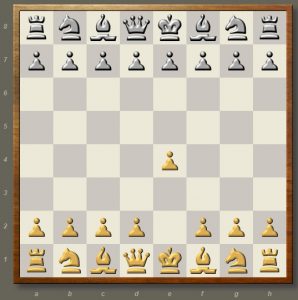
But then he saw the pawn in front of the light-colored king slide forward two squares and stop moving. It was the oldest move in the book, just about. Damiano played it as early as the 1500s, and Greco popularized it further – it was called “The Quiet Opening,” or Giuoco Piano, and it was the first opening he’d ever learned.
It was the only opening he needed to know, as it turned out.
Magnus considered testing the limits of the self-adjustment rule by saying “J’adube,” or “I adjust,” but it would have been redundant.
He looked over at the absence of the clock, and at where he imagined The Devil’s face to be, eye-level across the board from him. If the designers had really known what they were doing, they’d just have put a mirror there.
A soft, cheerful giggle emanated from the back of his throat, seemingly beyond his control, but he checked himself before quietly clearing his throat and speaking.
“I offer the draw.”